Call Us: +86-769-22654041Email: cz004@czjs168.com
enLanguage

Electronics

Why Choose Us?

Rich Experience

Dongguan Chengzhu Metal Products Co., Ltd. was established on April 28, 2013. It is an enterprise integrating the molding, research and development, production and marketing of light alloy materials.

One-stop Solution

The business scope includes the manufacturing of precision die casting molds for magnesium alloys, aluminum alloys and other light alloys, and the R&D, design, production and sales of die castings.

Widely Used Products

Products are mainly used in medical equipment, unmanned aircraft parts, robot/manipulator parts, new energy vehicle parts, motorcycles, electric vehicles, Motorized scooter, electric tools, sports equipment, 3C, LED, industrial parts and other fields.


What Are the Products of Electronics


Motor End Cover Aluminum Alloy Die Casting
Motor end cover aluminum alloy die casting is a type of die-cast component used in the manufacturing of motors and other electrical devices. It is produced using the die-casting process with aluminum alloys specifically chosen for their mechanical properties and suitability for the application.


Radiator And Bracket Aluminum Alloy Die-Casting Parts
Radiator and bracket aluminum alloy die-casting parts play a crucial role in various industries, including automotive, aerospace, electronics, and more.


Aluminum Alloy Die-Casting Part Properties


Aluminum alloy die-casting parts with a wide range of properties are used in engineering structures. Alloy systems are classified by a number system (ANSI) or by names indicating their main alloying constituents (DIN and ISO). Selecting the right alloy for a given application entails considerations of its tensile strength, density, ductility, formability, workability, weldability, and corrosion resistance, to name a few. Aluminium alloys are used extensively in aircraft due to their high strength-to-weight ratio.


Aluminium alloys typically have an elastic modulus of about 70 GPa, which is about one-third of the elastic modulus of most kinds of steel and steel alloys. Therefore, for a given load, a component or unit made of an aluminium alloy will experience a greater deformation in the elastic regime than a steel part of identical size and shape.


Stiffer and lighter designs can be achieved with Aluminium alloy than is feasible with steels. consider the bending of a thin-walled tube: the second moment of area is inversely related to the stress in the tube wall, i.e. stresses are lower for larger values. The second moment of area is proportional to the cube of the radius times the wall thickness, thus increasing the radius (and weight) by 26% will lead to a halving of the wall stress. For this reason, bicycle frames made of aluminium alloys make use of larger tube diameters than steel or titanium in order to yield the desired stiffness and strength.


An important structural limitation of aluminium alloys is their lower fatigue strength compared to steel. In controlled laboratory conditions, steels display a fatigue limit, which is the stress amplitude below which no failures occur – the metal does not continue to weaken with extended stress cycles. Aluminium alloys do not have this lower fatigue limit and will continue to weaken with continued stress cycles.


Motor End Cover Aluminum Alloy Die Casting Methods
 

While the overall process of aluminum alloy die casting remains the same, there are two methods used for injecting molten metal into the die cavity: hot chamber and cold chamber methods. The choice between these methods depends largely on the melting points of the metals involved.

Motor End Cover Aluminum Alloy Die Casting

Hot Chamber Die Casting Method

Hot chamber die casting involves heating the metal inside the casting chamber. This method is suitable for low melting temperature alloys such as magnesium, lead, and zinc. It is ideal for alloys that do not erode metal cylinders or plungers.
Advantages of hot chamber die casting include:
● Longer die life due to the lower melting points of the alloys used.
● Reduced porosity.
● Faster die casting cycle times compared to cold chamber casting.
● Efficient die designs.

Cold Chamber Die Casting Method

In cold chamber die casting, the metal is melted in a separate furnace and then transferred to the casting chamber. The molten metal is ladled into the casting machine and shot into the die cavity via a hydraulic plunger. This method is perfect for metals with high melting points, such as aluminum, brass, or copper.
Advantages of cold chamber die casting include:
● Produces denser metal castings.
● Lower maintenance cost.
● Higher level of quality control due to the injection process.

2


Aluminum Alloy Die Casting Advantages
 
01/

Die-cast parts are relatively cheaper and produce uniform quality for large volume production. Lower labour costs are due to semi or fully automated processes.

02/

Intricate forms and complex shapes can be cast easily, with part sizes ranging from 25g to 25Kg.

03/

Parts with walls as thin as 0.38 mm are possible because of the high pressure used during the process.

04/

Because the molten metal rapidly cools at the die walls, the casting has fine-grained hard skin with excellent strength. As a result, as the wall thickness decreases, the strength-to-weight ratio of die-cast components increases.

05/

Generates smooth surfaces for bearings that would otherwise be machined.

06/

It can generate net shape products at high rates requiring little or no post-processing.

07/

Excellent dimensional accuracy and good surface finish – 0.8-3.2 um Ra.

08/

Smaller pieces can be manufactured using either multi-cavity die or miniature aluminum alloy die casting.


How Aluminum Alloy Die Casting Works
 

Mold Design

The first step in the aluminum alloy die casting process is designing the mold, which is made of non-ferrous metal. The mold is designed to the exact specifications of the desired part.

Mold Preparation

The mold is prepared by applying a lubricant to prevent the molten metal from sticking. The mold is then closed and clamped shut.

Injecting Molten Metal

Molten metal is injected into the mold at high pressure using an aluminum alloy die casting machine. The pressure ensures that the mold is completely filled, creating a consistent part.

Part Cooling

The mold is cooled using a cooling system, which helps the molten metal solidify and take the shape of the mold.

Part Ejection

Once the part has solidified, the mold is opened, and the part is ejected from the mold using ejector pins.

Post-Processing

The part is cleaned and finished, which may involve removing any excess material, polishing, applying a protective coating, or other post-processing techniques.


Aluminum Alloy Die-Casting Parts Design – 3 Factors to Consider


Mold Design

The first key factor is mold design. The design needs to be efficient to ensure that melted aluminum can be injected and parts can be extracted effortlessly. Every mold has a parting line (the line that separates the two halves), and the designer should consider this line before finalizing the design.


Location of the Injection Point

The next important consideration is the location of the injection point. Multiple injection points can be added if there is a risk of the melted aluminum solidifying before reaching every crevice in the die. Proper placement of injection points also helps in filling the cavities effectively.


Wall Thickness

The wall thickness of the parts is another important consideration. With advanced automation technology and sophisticated machines, there is no strict minimum thickness requirement. However, for optimal results, it is best to maintain a consistent wall thickness.


Aluminum Alloy Die-Casting Parts Benefits
 

It is lightweight
Aluminum alloy die-casting parts are lightweight, with a density of about 2.67g/cm3. Die-cast aluminum's small weight benefits the vehicle's overall weight reduction. As a result, fuel efficiency improves.


It is an effective electric conductor
Electricity is efficiently conducted by die-cast aluminum. Its thermal conductivity is 120 w/mk. As a result, it is useful in processes that require heat dissipation, such as those involved in the production of heat sinks.


Outstanding machinability
The excellent machinability of aluminum alloy die-casting parts is another important characteristic.
Aluminum is simple to machine using typical methods such as drilling and milling. Additionally, it functions well with more advanced techniques like CNC machining. Due to the casting process, aluminum has a more solid surface, making CNC machines more efficient to use.


Corrosion resistant
Another important feature that makes aluminum alloy die-casting parts in great demand is their ability to resist corrosion. This is because when exposed to air, a thin film of aluminum oxide usually gathers on it. It guards against the metal reacting with the environment.


High ratio of strength to weight
Aluminum alloy die-casting parts have a good strength-to-weight ratio despite being relatively light. It is suitable for applications requiring strength because it is always strong.


Has high precision
Aluminum alloy die-casting parts have a high level of precision, making them simple to cast into complex designs. It quickly melts due to its low melting point of 660 degrees, which makes it simple to cast into molds. Additionally, because of its high fluidity, it can quickly fill mold voids. As a result, the parts are more precise and detailed.


The Importance of Aluminum Alloy Die-Casting Parts


Typical applications of die cast aluminum alloys include:
Alloy 380.0 - Lawnmower housings, gear
Alloy A380.0 - Streetlamps housings, typewriter frames, dental equipment
Alloy 360.0 - Frying skillets, cover plates, instrument cases, parts requiring corrosion resistance.
Alloy 413.0 - Outboard motor parts such as pistons, connecting rods, and housings
Alloy 518.1 - Escalator parts, conveyor components, aircraft and marine hardware and lit tings.
With die casting, it is possible to maintain close tolerances and produce good surface finishes. Die castings are best designed with uniform wall thickness: minimum practical wall thickness for aluminum alloy die castings is dependent on casting size.
Die castings are made by injection of molten metal into metal molds under substantial pressure. Rapid injection and rapid solidification under high pressure combine to produce a dense, fine-grain surface structure, which results in excellent wear and fatigue properties. Air entrapment and shrinkage, however, may result in porosity, and machine cuts should be limited to 1.0 mm to avoid exposing it.
Aluminum alloy die castings usually are not heat treated but occasionally are given dimensional and metallurgical stabilization treatments.
Die castings are not easily welded or heat treated because of entrapped gases. Special techniques and care in production are required for pressure-tight parts. The selection of an alloy with a narrow freezing range also is helpful. The use of vacuum for cavity venting is practiced in some die casting foundries for production of parts for some special applications.
Approximately 85% of aluminum alloy die castings are produced in aluminum-silicon-copper alloys (alloy 380.0 and its several modifications). This family of alloys provides a good combination of cost, strength, and corrosion resistance, together with the high fluidity and freedom from hot shortness that are required for ease of casting. Where better corrosion resistance is required, alloys lower in copper, such as 360.0 and 413.0 must be used.
Alloy 518.0 is occasionally specified when highest corrosion resistance is required. This alloy, however, has low fluidity and some tendency to hot shortness.


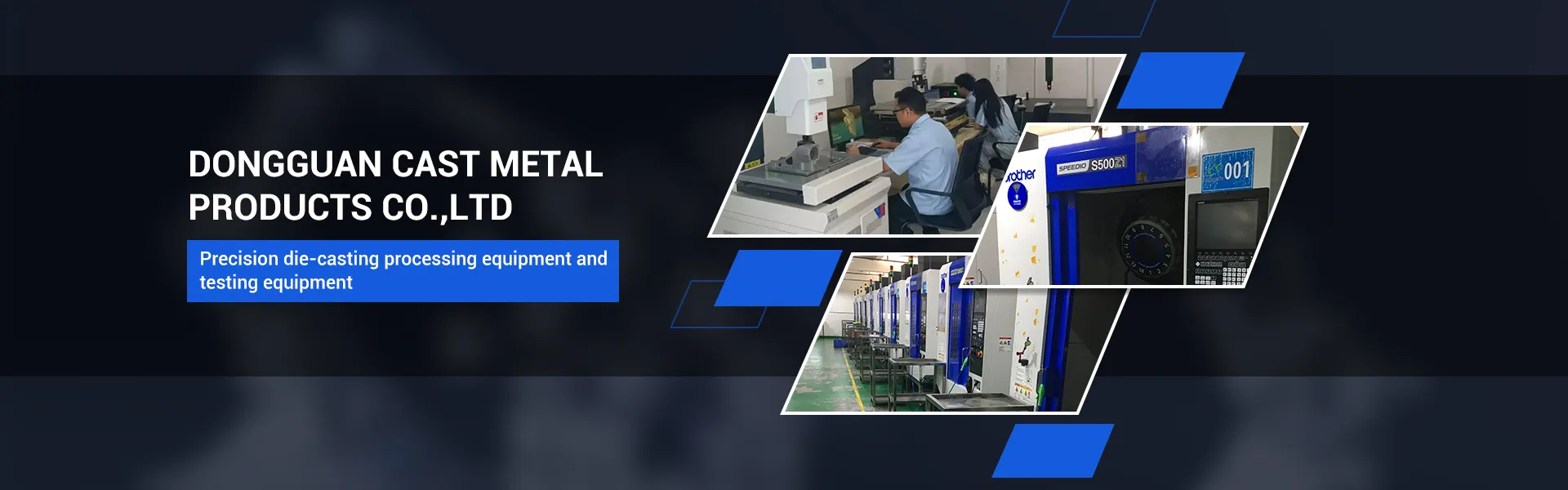
Our Factory


Dongguan Chengzhu Metal Products Co., Ltd. was established on April 28, 2013. Its registered address is located at No. 1, 1st Street, Fujie, Tangqiu Village, Liaobu, Dongguan City. Its legal representative is Zhao Chenhuang, with a registered capital of 3 million yuan. It is an enterprise integrating the molding, research and development, production and marketing of light alloy materials, and a well-known enterprise in Guangdong Province producing light alloy products.
The business scope includes the manufacturing of precision die casting molds for magnesium alloys, aluminum alloys and other light alloys, and the R&D, design, production and sales of die castings, which are mainly used in medical equipment, unmanned aircraft parts, robot/manipulator parts, new energy vehicle parts, motorcycles, electric vehicles, Motorized scooter, electric tools, sports equipment, 3C, LED, industrial parts and other fields.


productcate-1-1


FAQ


Q: Is post-machining always required after aluminum alloy die casting?

A: Aside from trimming or deburring operations, post-machining your parts is not necessarily required after aluminum alloy die casting. Post-die-casting machining may be required for the final part if tight tolerances or specialized surface finishes are required, etc.

Q: What is the difference between mold and aluminum alloy die casting?

A: Aluminum alloy die casting and permanent-mold casting are two key methods in metal part production. Aluminum alloy die casting injects molten metal into a steel mold under high pressure, ideal for small to medium-sized parts like those made of zinc, aluminum, and magnesium. It offers high precision, complex shapes, and efficient production rates.
On the other hand, permanent mold casting pours molten metal into a reusable mold, typically made of steel or cast iron, suitable for larger parts composed of alloys like brass, bronze, and iron. Permanent mold casting is cost-effective, supports a variety of materials, and produces parts with high strength and good surface finish. The choice between the two depends on factors such as part size, complexity, and material properties.

Q: What you need to know about aluminum alloy die casting?

A: Aluminum alloy die casting is a manufacturing process in which molten metal is poured or forced into steel molds. The molds—also known as tools or dies—are created using steel and are specially designed for each project. This allows each component to be created with accuracy and repeatability.

Q: Does aluminum alloy die casting rust easily?

A: While aluminium doesn't rust, it does corrode. The aluminium oxide coating is highly resistant and renews itself if damaged keeping the metal relatively safe from corrosion. But some factors can cause the coat to become unstable, thus exposing the metal.

Q: How long does aluminum alloy die casting take?

A: The aluminum alloy die casting cycle time depends on the weight of the components. While typically a very quick process, aluminum alloy die casting can take from a few seconds for small components to a few minutes for large, heavier components. The quick cycle times allows you to complete high production runs as efficiently as possible.

Q: What are the challenges in aluminum alloy die castings?

A: Due to their high heat conductivity, enhanced solidification shrinkage, surface oxide development, and high coefficient of thermal expansion, aluminium alloys present a more significant welding challenge than other materials. The creation of hydrogen gas porosity makes welding aluminium alloys more challenging.

Q: Is aluminum alloy die castingdurable?

A: Durability: Aluminium is a highly durable metal that can withstand extreme temperatures and weather conditions. Unlike other metals, aluminium does not rust or corrode, which makes it an ideal choice for doors and windows. In fact, aluminium can last up to three times longer than other materials, such as wood or steel.

Q: Does aluminum alloy die casting scratch easily?

A: The good news is that aluminium is highly scratch-resistant - though not 100% impervious.

Q: Is aluminum alloy die casting good quality?

A: Aluminum is much lighter than other metals, which makes it ideal for use in applications where low weight is important. Aluminum alloy has a high strength-to-weight ratio, and is much stronger than many other materials of a similar density.

Q: How to cast aluminum alloy die casting?

A: Generally, most aluminum casting processes involve heating the aluminum (and other metal) and pouring them in molten form into a prepared mold with the desired product design. Afterward, the molten aluminum cools down, solidifies, and takes the shape of the cavity.

Q: What is the difference between cast aluminum and aluminum alloy die casting?

A: Aluminum alloy die casting not only has appropriate mechanical properties but also has excellent corrosion resistance, thermal conductivity, and polishing properties. In the casting process, pure aluminum has poor fluidity, good thermal conductivity, high melting point and good oxidation resistance.

Q: What is the maximum thickness for aluminum alloy die casting?

A: However, as a general guideline, the maximum wall thickness for aluminum and zinc aluminum alloy die casting is typically around 25mm (1 inch). This maximum thickness is not a hard and fast rule and may need to be adjusted based on the specific requirements of the application.

Q: What is the process of aluminum alloy die casting?

A: Aluminum alloy die castings for aluminum alloy are melted in a furnace and then injected into the dies by the aluminum alloy die casting machine. Once the liquid aluminum is injected into the dies, it rapidly cools and solidifies into the final cast part.

Q: Does aluminum alloy die casting use a lot of energy?

A: Aluminum alloy die casting machines, widely used in manufacturing industry, consume a significant amount of energy. To reduce energy consumption, the primary task is to accurately characterize and evaluate the current performance.

Q: What is the best aluminum alloy die casting for casting?

A: A380 aluminum alloy die casting is the most common aluminum alloy die casting material, because it combines easy casting, easy machining, good heat transfer and other characteristics. It has strong variability, bearing pressure, and high temperature split resistance. Aluminum alloy die casting can have significant advantages over other manufacturing processes, which often lead to major cost savings, not only in the part price itself but also in the overall cost of production. When you cast a part, you can create complex net shapes, including external threads and complex internal features with minimal draft angles—minimizing secondary operations. You can also combine multiple parts into a single part, eliminating assembly operations and lowering labor costs, with the added benefits of simplified stock control and greater component consistency.

Q: What are the 3 basic methods of aluminum alloy die casting?

A: Three primary metal casting methods can be used to cast aluminum: aluminum alloy die casting, permanent mold casting, and sand casting.

Q: Why would you use aluminum alloy die casting?

A: Aluminum alloy die casting is characterized by high dimensional accuracy and allows for the mass production of thin-walled products with complex shapes. aluminum alloy die casting also has the advantage of producing smooth casting surfaces requiring less machining after molding.

Q: What is the pressure for aluminum alloy die casting?

A: There are two forms of pressure aluminum alloy die casting: low-pressure aluminum alloy die casting (LPDC) and high-pressure aluminum alloy die casting (HPDC). With LPDC, the metal is injected into the mold at low pressures, usually between 2–15 psi. HPDC injects the alloy into the mold at high pressures, usually between 1,500 and 25,400 psi.

Q: What is the raw material for aluminium casting?

A: Silicon, iron, copper, manganese, magnesium, chromium, and zinc are used to increase strength and to improve finish. Titanium and Boron are used for grain refinement which is a reduction in the size of the grains, creates a more consistent grain, and better extrudability.

Q: Is aluminum alloy die casting expensive?

A: Aluminum alloy die casting can be expensive, but it depends on factors such as the complexity of the product, the type of metal used, and the volume of production.

We're professional electronics manufacturers in China, specialized in providing high quality OEM service. We warmly welcome you to buy high-gradeelectronics made in China here from our factory.

Motor End Cover Aluminum Alloy Die Casting, Radiator And Bracket Aluminum Alloy Die casting Parts

(0/10)

clearall